Sections in the US State Department and Pentagon have always felt more comfortable dealing with all powerful Pakistani generals instead of elected civilians, points out Rana Banerji, who headed the Pakistan desk at RA&W.
'When one air force (India's) hits the other's airbases with impunity and that air force (Pakistan's) is not able to respond, then the air force, which has put the other's airbases out of commission, has won.'

By signing the 123 Agreement, India is effectively giving up it 34-year-old nuclear deterrent at a time when China is enhancing its own nuclear capability. (So is Pakistan; both China and Pakistan are, unsurprisingly, delighted with the 123 Agreement). In return, we will be "allowed" to give Western and Russian civil nuclear infrastructure companies business (from Indian taxpayers' money) worth over $120 billion

'This was undoubtedly a premeditated strategy to thwart India's entry into the NSG.' 'If India hopes to be a major player, it must use its rising clout on the world stage to influence amenable members of the group to alter such discriminatory practices and ensure fair rules of engagement,' says Vivek Gumaste.

After nearly two decades of nuclear competition with Pakistan, India with the several long-range ballistic missiles in development is seemingly now paying attention to its future strategic relationship with China, a think-tank report has said.
In the wake of the nuclear emergency in Japan, Prime Minister Manmohan Singh should have ensured a 'check-up' of safeguards at nuclear power plants before declaring 'Everything is fine' at those sites, Dr A N Prasad, former director, Bhabha Atomic Research Centre, tells Rediff.com's Sheela Bhatt.

Mukherjee said the international community could have trade with India after a safeguards agreement is in place.
'Will this near-war, India's strongest military response so far, buy India another seven years of deterrence?' asks Shekhar Gupta.
One of the biggest myths being propagated is that nuclear cooperation with the US is the answer to India's energy crisis, which in any case would not see the light of the day before 2016. Also Indian Parliament and citizens have been kept in dark about the cost of electricity from foreign-built nuclear power reactors.

Dr Bhabha and Dr Sarabhai didn't feel guilty for their ambitions; it was for those 'mad scientists' that India is a powerhouse -- both at the atomic level and in the vastness of space, observes Kumar Abishek.
India's civil nuclear liability regime has raised serious questions about the country's capacity addition programme. In an interview with Sanjay Jog, G R Srinivasan, former vice-chairman of the Atomic Energy Regulatory Board and currently principal associate-nuclear power business in GMR Energy Ltd, says the regime is tremendously unbalanced and may adversely affect the nuclear capacity addition programme.

Whether Trump will actually press ahead with the oil sanctions remains unclear, since keeping Russian oil out of the world market risks high oil prices which could boomerang on the US economy and be damaging politically for Trump, points out Ambassador M K Bhadrakumar.
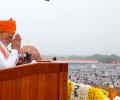
Prime Minister Narendra Modi addressed the nation on Independence Day, focusing on economic growth, self-reliance, and national security. He emphasized manufacturing quality products at affordable prices, supporting farmers, and combating terrorism and infiltration.
According to Russian journal Vedomosti, the agreement was made when Prime Minister Narendra Modi met Russian President Vladimir Putin in Goa BRICS summit.

'...it should not delude itself into thinking that India's security or its great-power ambitions will be advanced by those partnerships.'
'Instead, what India should focus on is on riding out the next three-and-a-half years of Trump's presidency with minimal damage to itself.'

'Pakistan has found itself in a favourable position after Operation Sindoor by appreciating the mediation as claimed by Trump and recommending him for the Nobel Peace Prize.'
The Indian Nuclear Energy Pool, meant to insure risks from nuclear reactors, may take longer to be set up. While the idea of forming a pool was mooted earlier this year, it has reached a deadlock owing to differences among the stakeholders on certain clauses.
'No respite from economic pain is worth the loss of dignity and self-respect,' asserts former foreign secretary Shyam Saran.

The Indian Navy, which was earlier looking towards the US for design expertise, technical know-how and operational practices, is now considering the advantages of working with the Royal Navy.
If you are proud of your birthplace you will be happy, says Vijay Papparao, in a conversation with A Ganesh Nadar
India for the first time on Wednesday voted against Russia during a "procedural vote" at the United Nations Security Council on Ukraine, as the 15-member powerful UN body invited Ukrainian President Volodymyr Zelenskyy to address a meeting through a video tele-conference.

The highlight of Tuesday's debate on Operation Sindoor was the speech by Prime Minister Narendra Modi, with the rebuttal by Congress's Wayanad MP Priyanka Gandhi coming a close second.
Pak approaches NSG for a nuclear deal similar to the US-India one

'Pakistan is an ally who gives the US access.' 'If we have a presence there, it puts us that much closer to China and puts our assets closer to China and Iran.'
In a significant message to the business lobby in Washington, the Union Cabinet on Thursday gave its nod to the Civil Nuclear Liability Bill.The move will encourage the nuclear power plant manufacturing companies, which have been eyeing the Rs 60,000-crore plus market in India, for the next 5-10 years. According to sources, the government will fix the civil liability at approximately Rs 2,400 crore for the manufacturers.

Modi praised the contribution of nuclear scientists in the successful implementation of India's three-stage nuclear programme.
Westinghouse Electric Company is set to begin discussions with India's Nuclear Power Corporation to reach an agreement on the deployment of Westinghouse AP1000 (TM) nuclear power plants in India.

'Forensics experts say in all such unexplained deaths of scientists and engineers involved in the nuclear programme, fingerprints are absent, as also other clues that would assist the police in identifying the culprit(s).' Prasanna D Zore/Rediff.com reports on a petition that demands a Special Investigation Team probe the mysterious deaths of India's nuclear scientists.
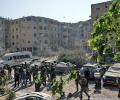
At the end of the day, for many worldwide, the ongoing mutual attacks between Israel and Iran would seem a contest devoid of any moral high ground and only a bout between two ordinary adversaries, one that nevertheless risks spinning out of control into a larger conflagration, notes Shyam G Menon.
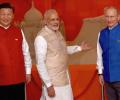
'With Pakistan's 'first use doctrine' threatening the use of nuclear weapons early in a war with India, the S-400 will shield vulnerable targets like Delhi and Mumbai, complicating Pakistan's targeting calculations.'

The idea of weaponization got a fillip from an unexpected quarter. In the last week of October 1985, Rajiv met US President Ronald Reagan. Reagan told Rajiv, 'Pakistan has already made a bomb.' When Rajiv started talking about disarmament, the US president cut him short, 'Don't talk theory, think of your own protection.'

The Reserve Bank should focus on making liquidity easier rather than cutting rates if the intent is to drive growth, Axis Bank's chief economist Neelkanth Mishra said on Tuesday. Mishra, who is also a part-time member of the Economic Advisory Council to the PM, said the rate cut announced earlier this month or even the subsequent ones if they were to come will not end up increasing borrowings as the scarce liquidity will hamper transmission.

The government has approved the construction of two indigenously designed nuclear attack submarines and is expected to ink contracts next month to procure 26 naval variant of Rafale jets and three Scorpene submarines, Navy Chief Admiral Dinesh Tripathi said on Monday.

China showcased its latest military hardware, including hypersonic and ballistic missiles, during a parade commemorating the 80th anniversary of its victory against Japanese aggression in World War II. President Xi Jinping called for world peace and national rejuvenation.

Since $4-5 billion (Rs 18,670-23,340 crore) will be needed to set up each nuclear reactor, capital costs alone add up to $200-250 billion (Rs 9,33,600-11,67,000 crore). Then there are fuel costs, nuclear waste disposal, reprocessing, consultants & advisors and, of course, the financial market aspects of raising all that money.

A nuclear scientist and a chemical engineer, Dr Sethna was pioneer in establishing India's first reprocessing plant in 1959. India's first nuclear test was possible because of the Plutonium from this plant when the country was under tremendous pressure to sign the nuclear non-proliferation treaty by the United States.
